Writing
Machine Learning (20) — Dimensionality Reduction
Why reduce dimensions, and main methods: PCA, LDA, and topic models.
Preface: every outcome follows from causes; when building ML models, complex features often require dimensionality reduction. Below are the main principles.
Why Reduce Dimensions?
In real projects, feature selection/dimensionality reduction is often required because:
-
Multicollinearity: correlated features destabilize the solution space and weaken generalization;
-
High-dimensional spaces are sparse, making patterns hard to find;
-
Too many variables obscure structure;
-
Looking at single-variable effects may miss joint relationships.
Goals of feature selection/reduction:
-
Reduce the number of features
-
Keep features as independent as possible
Sometimes the feature matrix is simply too large—slow training, long runtime.
Common methods:
-
PCA
-
LDA
-
Topic models for dimensionality reduction
PCA Principle
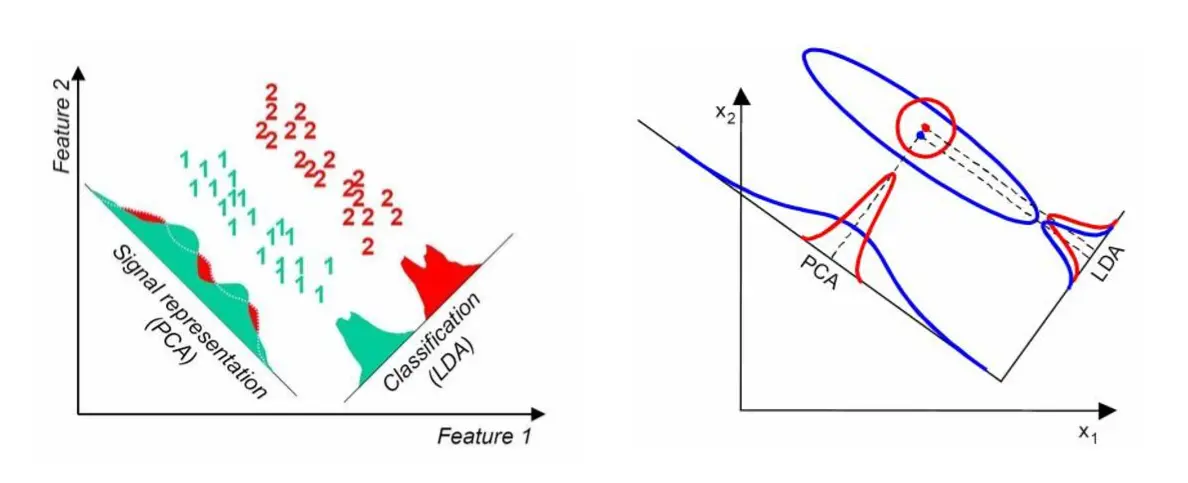
Principal Component Analysis (PCA): merge high-dimensional features into lower dimensions—unsupervised. Find a linear projection to a lower space maximizing variance (maximum variance theory), keeping much of the original structure with fewer dimensions.
-
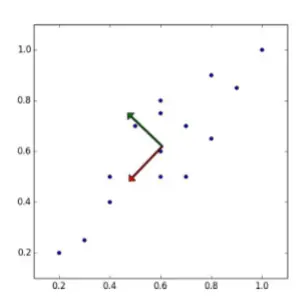
Choosing components: with n original dimensions, pick the direction of maximum variance as the first axis; the second orthogonal to the first; the third orthogonal to both; repeat until the desired dimension. These directions are “principal components.”
-
Math: objective—maximize projected variance. Projection matrix W; point x_i projects to Wᵀx_i (assume X is centered, z-score). Spread projections across dimensions → maximize sum of variances:
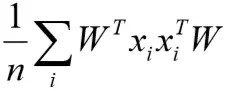 PCA objective:
 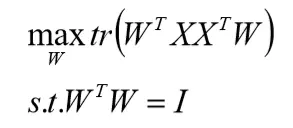 Lagrange solution:
  Partial derivatives:
 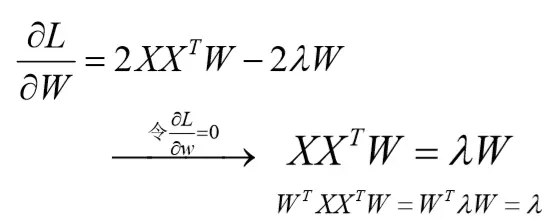 Treating XXᵀ as A, solving W is eigen-decomposition of A—PCA on centered data is eigenvalues/eigenvectors of the covariance matrix. Eigenvalues are often computed via SVD; XXᵀ is diagonal so eigen-decompose:
 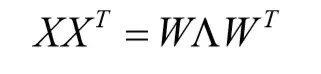 SVD on X gives:
LDA
Linear Discriminant Analysis (LDA): supervised feature merging using class labels. Project labeled points to lower dimensions so classes form tight clusters—same class closer after projection. In one sentence: “minimize within-class variance, maximize between-class variance.”
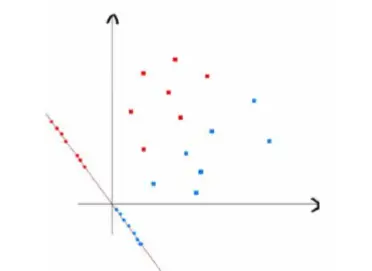
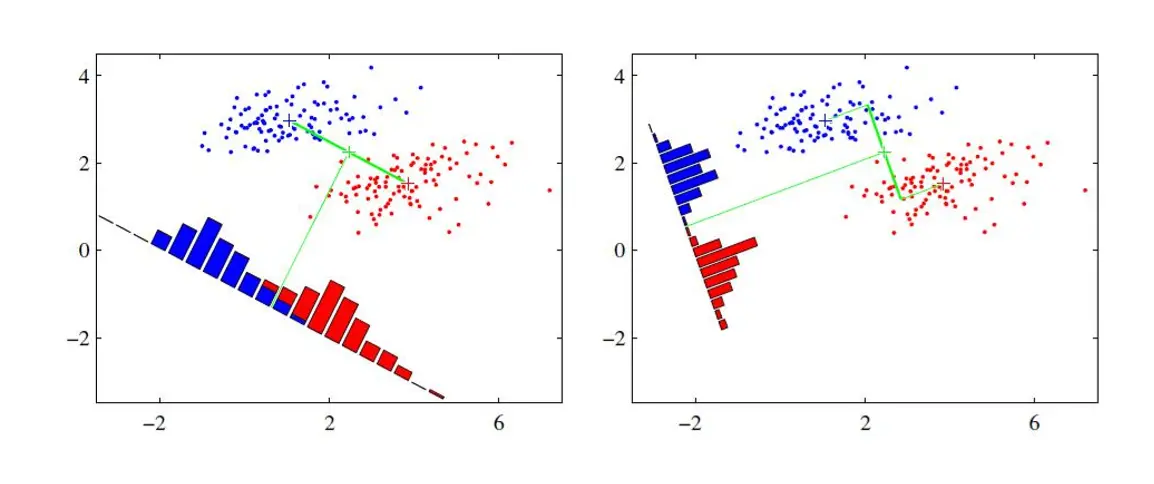
*Math (minimize within-class variance, maximize between-class variance)
Let the projection be w; linear transform:
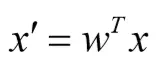
Projected data is one-dimensional.
For binary classification, threshold the projected value into classes. Class centers represent class info—maximize distance between centers:
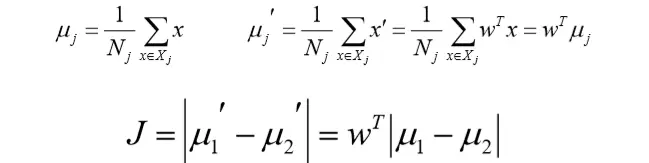
Also require within-class samples to stay close—minimize within-class covariance of projections:

Combined objective:

Transform the objective (A, B square; A positive definite):
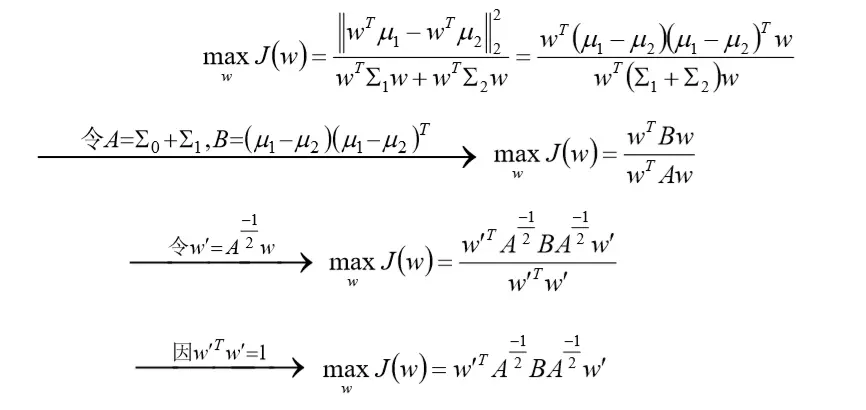
Same form as PCA’s optimization—eigen-decompose the middle matrix.
Comparison
Similarities:
-
Both reduce dimensionality
-
Both use matrix decomposition
-
Both often assume Gaussian data
Differences:
-
LDA is supervised; PCA is unsupervised
-
LDA reduces to at most k−1 dimensions (k classes); PCA has no such cap
-
LDA can also classify
-
LDA picks the projection best for separation; PCA picks maximum variance direction